

H-1B visa process Overcoming H-1B Cap Limitations via Cap-Exempt Alternatives
Introduction
The H-1B visa is one of the most sought-after avenues for foreign professionals seeking employment in the United States. However, the annual H-1B cap and lottery system pose significant challenges for both employers and skilled workers. Each year, thousands of qualified applicants are unable to obtain H-1B visas due to the limited number of slots available.
Fortunately, there are several cap-exempt options that allow foreign nationals to work in the United States without falling victim to the H-1B lottery. Understanding these options can help employers attract global talent and enable professionals to continue their careers in the U.S. despite H-1B cap restrictions.
Understanding the H-1B Cap Challenge
The U.S. government currently limits the number of new H-1B visas issued each fiscal year. The standard annual limit is 65,000 visas, with an additional 20,000 visas reserved for applicants with advanced degrees from U.S. institutions.
Due to overwhelming demand, U.S. Citizenship and Immigration Services (USCIS) operates a lottery system to select eligible applicants. Many highly qualified candidates are not selected, leading employers to seek alternative solutions.
This competitive process makes it important to explore visa categories and employment opportunities that are exempt from the H-1B cap.
What Is a Cap-Exempt H-1B?
Cap-free H-1B allows eligible employers to sponsor foreign workers without being subject to annual numerical limits or a lottery process.
Unlike cap-free employers, cap-free entities can file H-1B petitions throughout the year, providing greater flexibility and predictability.
Cap-free H-1B employment is particularly valuable for professionals who were not selected in the lottery but still want to work in the United States.
Organizations Eligible for Cap-Exempt H-1B Sponsorship
Several categories of employers qualify for cap-exempt status.
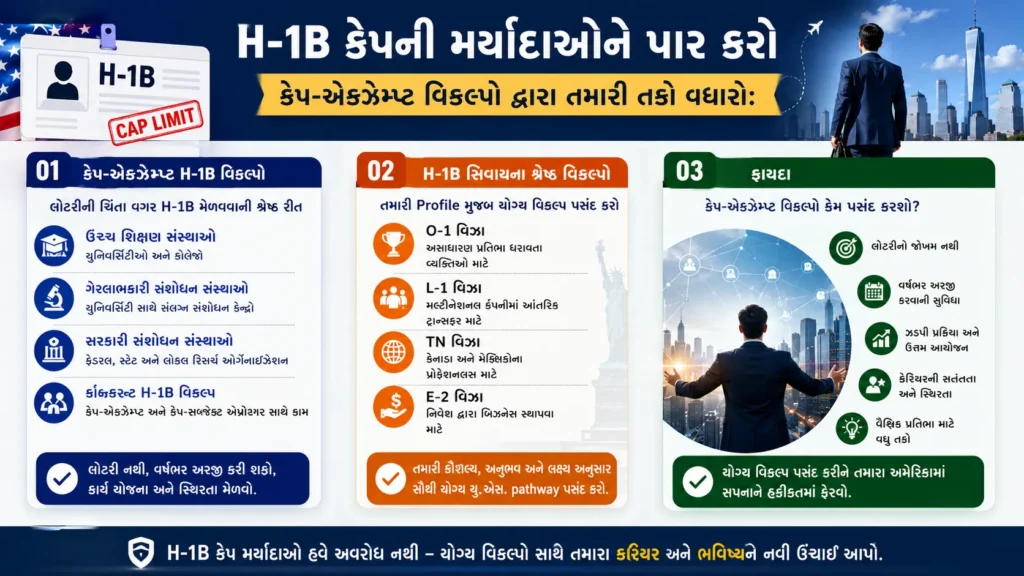
1. Higher Education Institutions
Universities and colleges are generally exempt from the H-1B cap. These institutions often employ international faculty, researchers, lecturers, and specialized staff members.
Examples include:
Public universities
Private colleges
Community colleges
Accredited educational institutions
Professionals directly employed by these institutions can often obtain H-1Bs without participating in the lottery.
2. Nonprofit Organizations Affiliated with Universities
Many nonprofit organizations maintain formal affiliations with higher education institutions. If the relationship meets USCIS requirements, these organizations may be eligible for cap-exempt H-1B sponsorship.
Examples include:
University research centers
Educational foundations
Medical research organizations
Educational partnerships
3. Nonprofit Research Organizations
Organizations whose primary mission includes research activities may also qualify for a limitation exemption.
These organizations often focus on:
Scientific research
Public health studies
Medical innovation
Technology development
Researchers, scientists, analysts, and technical professionals often benefit from employment opportunities in these settings.
4. Government Research Organizations
Federal, state, and local government research organizations are generally exempt from the H-1B cap.
Common examples include:
Government laboratories
Public health agencies
Defense research facilities
Environmental research departments
Such organizations routinely seek highly skilled international professionals in STEM fields.
(1) H-1B Cap Exempt Employers
(2) H-1B Cap Exempt Alternatives
(3) H-1B Lottery Alternatives
(4) Cap Exempt H-1B Visa
(5) US Work Visa Options
(6) O-1 Visa Alternative
(7) L-1 Visa Transfer
(8) TN Visa USA
(9) H-1B Visa 2026
(10) US Immigration for Professionals
Concurrent H-1B Employment Strategy
A lesser-known option involves concurrent H-1B employment.
Under this approach, a foreign worker can hold a cap-free H-1B position with a qualifying organization and work for a cap-subject employer at the same time.
This strategy can provide valuable flexibility and allow professionals to gain experience in the private industry while maintaining cap-free status.
However, proper legal guidance is essential to ensure compliance with immigration regulations.
Alternative Visa Options Beyond H-1B
In addition to cap-exempt H-1B opportunities, several other visa categories may provide viable alternatives.
Overcoming H-1B Cap Limitations
O-1 Visa for Individuals with Extraordinary Ability
The O-1 visa is designed for individuals who demonstrate extraordinary ability in fields such as:
Science
Technology
Education
Business
Arts
Athletics
Unlike the H-1B, there is no annual cap on O-1 visas.
Professionals with notable achievements, awards, publications, or industry recognition may qualify for this category.
L-1 Intracompany Transfer Visa
Multinational companies can transfer employees from foreign offices to U.S. operations through the L-1 visa program.
The L-1 category includes:
L-1A for executives and managers
L-1B for specialized knowledge employees
This visa is especially useful for global organizations looking to transfer key employees.
TN Visa for Canadian and Mexican Citizens
Citizens of Canada and Mexico may qualify for TN status under the United States-Mexico-Canada Agreement (USMCA).
Many professional occupations are eligible, including:
Engineers
Accountants
Scientists
Computer Systems Analysts
The TN visa offers a streamlined process and does not involve a lottery. E-2 Investor Visa
Individuals from treaty countries can qualify for an E-2 visa by making a substantial investment in a U.S. business.
Entrepreneurs and business owners often use this route to establish and operate companies in the United States.
Benefits of Pursuing Cap-Exempt Opportunities
Choosing the cap-exempt pathway offers several benefits:
No lottery risk
Applicants do not have to participate in the highly competitive H-1B lottery.
Year-round filing
Employers can submit applications at any time during the year.
Rapid workforce planning
Organizations gain greater certainty when recruiting international talent.
Career Continuity
Professionals can continue to work in the United States without having to wait for a future lottery cycle.
Access to specialized roles
Research institutions and universities often provide unique career opportunities that support long-term professional development.
How Employers Can Take Advantage of Cap-Free Hiring
Overcoming H-1B Cap Limitations
Employers facing a talent shortage should proactively seek partnerships with cap-free organizations.
Possible strategies include:
Collaborating with universities on research projects
Establishing joint employment arrangements
Recruiting candidates with existing cap-exempt status
Building relationships with nonprofit research organizations
These approaches could expand access to highly skilled global professionals by reducing reliance on the annual H-1B lottery.
Important Considerations
While cap-exempt options offer valuable opportunities, qualification requirements vary by institution and visa category.
Employers and foreign nationals should carefully evaluate:
Institutional qualifications
Job duties
Educational qualifications
Immigration compliance requirements
Long-term career goals
Consulting an experienced immigration counselor can help ensure successful outcomes and avoid unnecessary delays.
Trump’s name must be removed from Kennedy Center, judge orders
Conclusion
The H-1B lottery system continues to present significant challenges for both employers and international professionals. However, cap-exempt H-1B opportunities and alternative visa categories provide practical ways to overcome these limitations.
Universities, nonprofit research organizations, government research organizations, and alternative visa programs such as the O-1, L-1, TN, and E-2 visas provide valuable solutions for accessing the U.S. workforce.
By understanding and utilizing these options, employers can access top global talent while professionals can continue to build rewarding careers in the United States without relying solely on the H-1B lottery.